





Automate your family office
Schedule DemoHeading 1
Heading 2
Heading 3
Heading 4
Heading 5
Heading 6
Lorem ipsum dolor sit amet, consectetur adipiscing elit, sed do eiusmod tempor incididunt ut labore et dolore magna aliqua. Ut enim ad minim veniam, quis nostrud exercitation ullamco laboris nisi ut aliquip ex ea commodo consequat. Duis aute irure dolor in reprehenderit in voluptate velit esse cillum dolore eu fugiat nulla pariatur.
Block quote
Ordered list
- Item 1
- Item 2
- Item 3
Unordered list
- Item A
- Item B
- Item C
Bold text
Emphasis
Superscript
Subscript
As family offices have grown more sophisticated, managing diverse holdings, cross-border structures, and multi-generational wealth, many still rely on outdated tools, such as spreadsheets, to manage increasingly complex portfolios. While wealth has evolved, the systems used to manage it often haven’t kept pace.
Modern family office management software addresses this gap. These platforms centralise data, automate reporting, and offer real-time visibility across asset classes, entities, and ownership structures. They go beyond portfolio tracking to include ownership hierarchy dashboards, performance analytics across liquid and illiquid assets, and secure document vaults — all powered by automated data feeds.
Whether you’re running a single-family office or serving multiple clients in a multi-family model, our roundup of the best family office management software highlights solutions built for transparency, control, and scale. With the right system in place, family offices can reduce manual work, improve oversight, and focus on long-term wealth preservation.
What is family office management software?
Family office management software is a central platform that enables family offices to track wealth, manage investments, and report across complex structures with clarity and control. It’s built specifically for the needs of single and multi-family offices; supporting multi-entity ownership, diverse asset classes, and cross-currency reporting.
Unlike generic accounting systems, family office software focuses on investment oversight and reporting rather than bookkeeping. It consolidates data from banks, custodians, and alternative investment platforms to give a timely view of portfolio performance across entities.
In addition to simplifying reporting, many platforms help visualise ownership structures — showing how individuals, trusts, companies, and assets are linked — making it easier to understand who owns what, and where. The primary use cases include consolidated investment reporting, multi-entity structuring, data aggregation, and document management. These are all designed to reduce manual work and help family offices move from spreadsheets to secure, scalable infrastructure.
Top family office management software (2025)
As family offices face growing complexity — from managing diverse investments to navigating multi-entity ownership structures — the need for dedicated family office management software has never been more critical. These platforms are purpose-built to give family offices better control, visibility, and structure across their operations.Instead of relying on spreadsheets and disconnected tools, family office management software provides a unified view of wealth, enabling investment tracking, reporting, and document oversight in one secure system. With features like multi-asset performance reporting, automated data aggregation, and ownership visualisation, these tools help offices move from reactive administration to proactive management.Below are ten of the leading family office management software platforms available today, spanning a range of office sizes, regions, and use cases.
Asora
Year founded: 2021 | $$
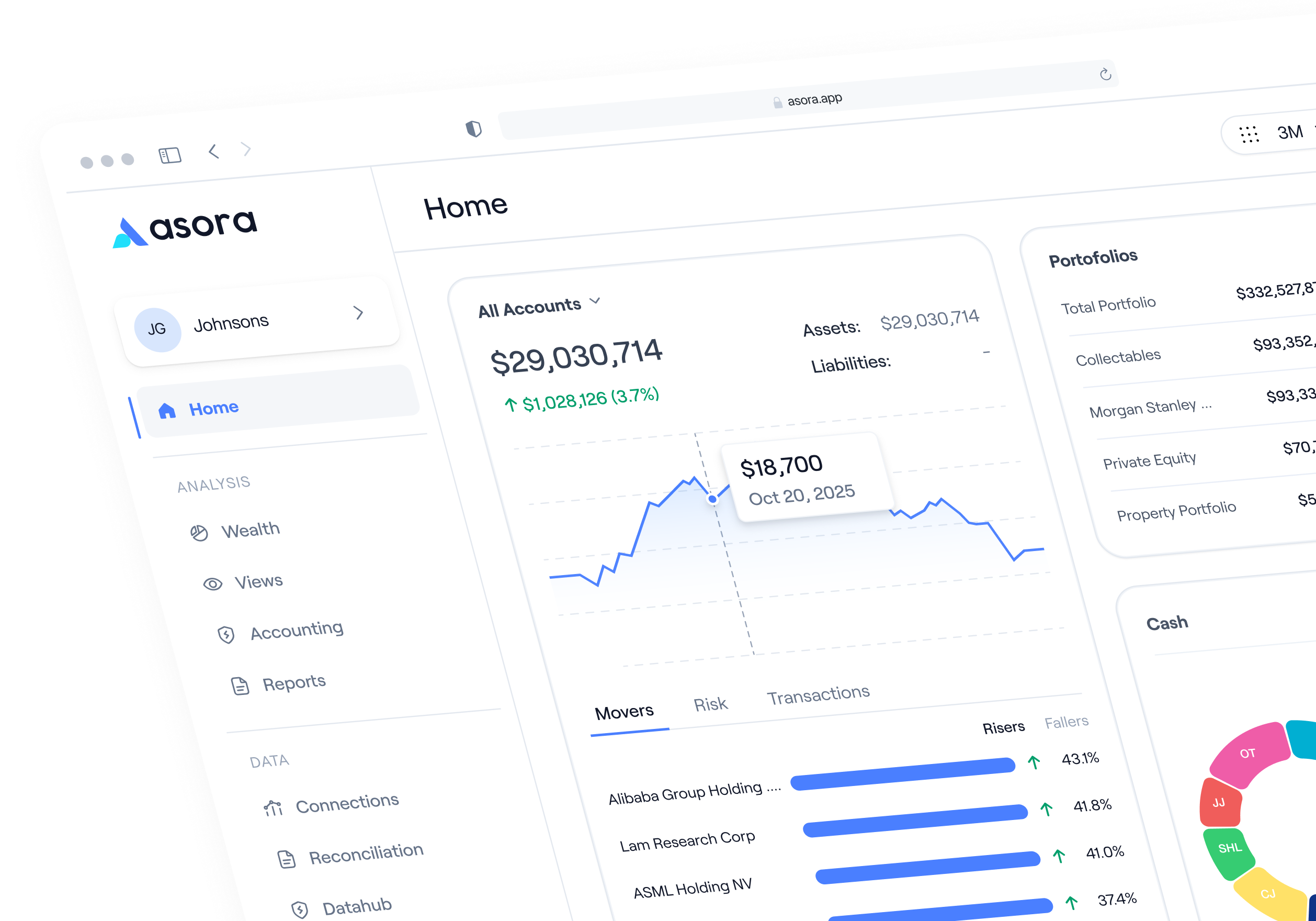
Asora is modern family office management software designed for lean teams and fast-moving offices. It combines data aggregation, multi-asset reporting, task management, pipeline tracking, and secure document storage into a single cloud-native platform. Automated data feeds from banks and custodians eliminate manual entry and provide real-time visibility into portfolios, entities, and ownership structures.
Asora is designed for fast deployment, intuitive navigation, and offers transparent pricing (starting at €800/month). That makes it ideal for family offices that want robust oversight without the friction of a complex implementation or hidden fees.
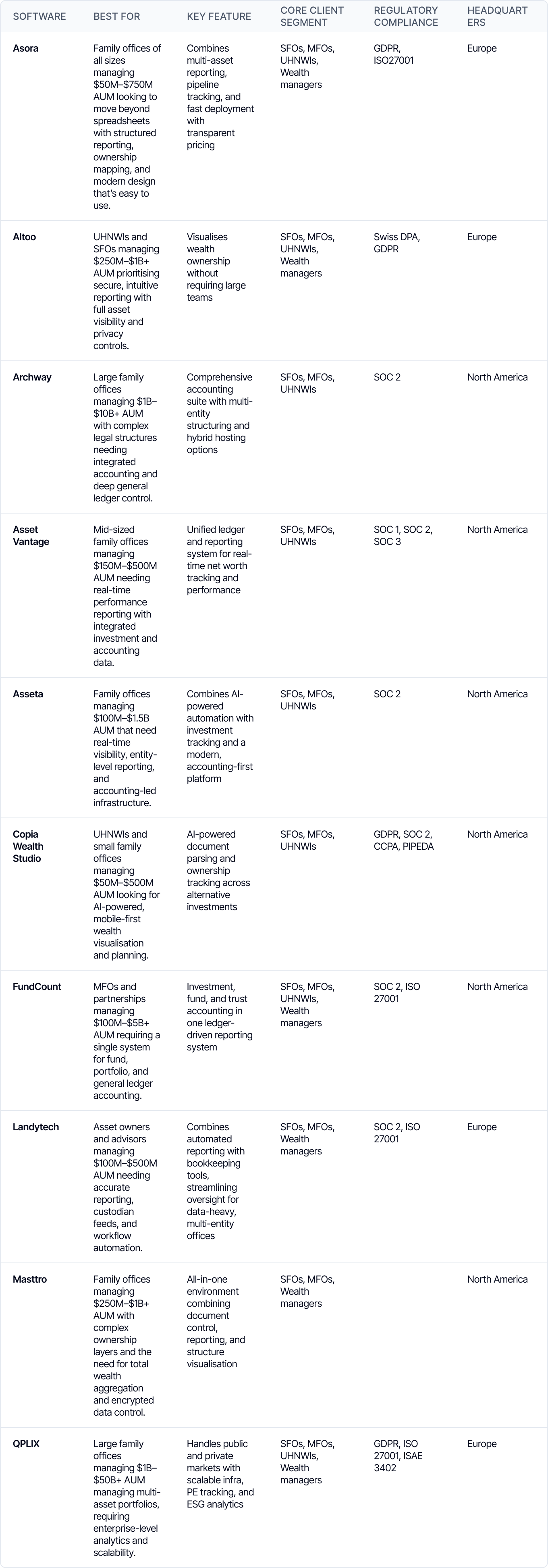
Best for: Family offices of all sizes managing $50M–$750M AUM looking to move beyond spreadsheets with structured reporting, ownership mapping, and want full control and clarity without heavy infrastructure or hidden costs.
Altoo
Year founded: 2017 | $$$Altoo's intuitive, Swiss-built dashboard brings clarity to complex ownership structures without requiring a large team. It supports both operational visibility and wealth reporting — including tools for cash flow planning and legal structure mapping, making it practical family office software, not just a reporting layer.
Best for: UHNWIs and SFOs managing $250M+ AUM, prioritising ease, privacy, and entity-level visualisation.
Archway
Year founded: Early 2000s | $$$$
Archway combines deep accounting functionality with outsourced service options. It supports complex multi-entity structures, detailed look-through reporting, and partnership accounting — all within a single system. Flexible deployment models (cloud, on-prem, or hybrid) give offices control over how they operate. This makes Archway more than an accounting tool; it’s an end-to-end operational and reporting solution tailored for families managing institutional-scale wealth.
Best for: Large, complex family offices managing $1B+ with multi-generational assets that need both robust accounting capabilities and optional back-office support.
Asset Vantage
Year founded: 2011 | $$$
Asset Vantage offers accounting-reporting integration in a single platform. Its native general ledger, real-time net worth tracking, and granular asset-level data make it ideal for family offices juggling financial complexity. Unlike typical accounting tools, it supports investment oversight across entities while maintaining audit-level precision.
Best for: Mid-to-large family offices managing $150M+ AUM, requiring detailed financial control and performance visibility in one system.
Asseta
Year founded: 2023 | $$
Asseta is a modern, accounting-led platform built for family offices that want consolidated oversight of investments and financials in one place. It streamlines workflows, supports complex structures, and delivers real-time visibility with AI-powered features.
Best for: Family offices managing $100M–$1.5B AUM that need integrated accounting, investment tracking, and entity-level reporting without operational sprawl.
Copia Wealth Studios
Year founded: 2021 | $$$
Copia Wealth Studios offers family office software that brings together operational tools and investment reporting in a streamlined interface. With AI-assisted document processing and configurable dashboards, it supports efficient data organisation, onboarding, and portfolio presentation.
Best for: Family offices and UHNWIs managing $50M–$500M AUM looking to automate workflows, manage reporting, and present complex data in a structured format.
Fundcount
Year founded: 1999 | $$$$
FundCount stands out for its proprietary investment ledger and powerful fund and trust accounting capabilities. It qualifies as family office management software by covering both complex entity accounting and deep portfolio analytics, especially for illiquid and alternative assets. Deployment flexibility adds to its appeal.
Best for: Structurally complex offices managing $100M–$5B+ AUM needing institutional-grade fund, trust, and entity accounting with full financial reporting.
Landytech
Year founded: 2018 | $$$
Landytech combines daily data aggregation, document parsing, and dynamic reporting. It centralises investment oversight, automates data workflows, and handles complex entity ownership, reducing manual reconciliation and improving risk visibility.
Best for: Multi-entity offices managing $100M–$500M AUM with high data complexity that need real-time oversight and automation at scale.
Masttro
Year founded: 2010 | $$$$
Masttro provides an end-to-end suite that integrates document workflows, ownership mapping, and reporting. It excels at presenting a consolidated view of complex estates, backed by AI-powered document automation and secure data aggregation, making it easy to consolidate complex financial and ownership information.
Best for: Large, global family offices managing $250M–$1B+ AUM seeking maximum security, full functionality, and entity transparency in one system.
QPLIX
Year founded: 2012 | $$$$QPLIX is selected for its strength in handling both liquid and illiquid assets in a unified platform, including detailed private equity tracking and ESG analytics. Its scalable infrastructure serves family offices alongside institutional clients, making it a strong operational and reporting hub.
Best for: Large, multi-jurisdictional family offices that manage institutional-style portfolios worth $100M–$500M+ and want an all-in-one backbone.
*All images from company websites, social media, or created for illustration.
How to pick the best family office management platform
Choosing the right family office management software starts with understanding your structure, asset mix, and internal capacity. While needs vary across single and multi-family offices, there are a few key capabilities that consistently separate the best platforms from the rest.
- Multi-entity support: Family offices often manage complex structures involving trusts, holding companies, partnerships, and foundations. Look for software that handles these entities natively and allows for consolidated or entity-specific views without duplicate data entry.
- Investment coverage: From listed securities to private equity, real estate, and hedge funds, the software should accommodate the full asset mix. Platforms that allow look-through reporting and track performance across both traditional and alternative assets offer far more visibility.
- Data aggregation: Manual data entry is time-consuming and error-prone. Leading platforms offer automated feeds from banks, custodians, and alternative asset portals, helping you streamline workflows and reduce reconciliation work.
- Custom reporting: Different stakeholders, such as principals, family members, investment teams, need different views. Look for tools that support on-demand dashboards, exportable reports, and the ability to slice data by entity, asset class, or timeframe.
- Ownership visualisation: Clarity around who owns what, and how different entities connect, is essential. Some platforms offer visual tools or hierarchical structures that help map and understand family ownership.
- Security and access control: Given the sensitivity of family data, best-in-class platforms include strong encryption, audit trails, and role-based permissions. This ensures that the right people have access to the right information.
- Ease of use: A platform is only useful if people actually use it. Look for intuitive interfaces, clean dashboards, and support that matches your team’s level of technical expertise.
Whether your priority is performance monitoring, entity-level reporting, or document management, the right software should reduce complexity, not add to it. The goal is simple: one system that gives
The need for family office management software
Family office management software is no longer a nice-to-have — it’s an essential tool for overseeing complex wealth in a structured, scalable way. Whether you’re managing a single-family office with a handful of entities or running a multi-family operation across jurisdictions, the right platform can bring clarity, control, and confidence to your day-to-day operations.
From performance reporting and multi-entity structuring to data aggregation and secure document management, the platforms featured in this list offer a range of capabilities to suit different needs and office models. While some focus on analytics and investment oversight, others combine reporting with operational infrastructure.
Ultimately, the best choice depends on your office’s complexity, internal capacity, and priorities. By investing in software that aligns with how your office works, and where it’s headed, you can reduce manual work, strengthen oversight, and free up your team to focus on strategic planning and long-term wealth preservation.
Ready to modernise your family office?
If you’re looking for modern family office software designed specifically for single and multi-family offices with $100 million to $1 billion+ in AUM, Asora combines intuitive design, real-time oversight, and streamlined reporting in a single platform.
Book a demo today to see how Asora can help simplify and elevate your operations.
FAQs: Family Office Management Software
What is family office management software used for?
It’s used to track investments, consolidate data across entities, generate reports, and give family offices a real-time view of their wealth. It replaces manual processes with scalable, centralised infrastructure.
Why should I use family office management software instead of my current spreadsheet?
Spreadsheets may work for basic tracking, but they quickly become error-prone and inefficient as your family office grows. Family office management software offers real-time data aggregation, entity-level reporting, and secure document storage — all in one place. It reduces manual work, improves accuracy, and gives you a scalable foundation to manage complex wealth more effectively.
Who should use family office management software?
Single-family offices, multi-family offices, and UHNW families who need better visibility across complex structures and asset classes. It’s useful for teams managing multi-entity ownership, alternative assets, or global portfolios.
What features should I look for in family office management software?
Look for multi-entity support, investment reporting, data aggregation, ownership visualisation, secure document storage, and easy-to-use dashboards. The right mix depends on your office’s size and structure.
Can family office management software handle private equity and other alternatives?
Yes. Most leading platforms track public and private assets — including real estate, hedge funds, and private equity — and support performance metrics like IRR and look-through reporting.
How does family office management software improve reporting?
It automates data feeds, centralises information across accounts and entities, and enables customisable reporting. This reduces manual work and improves accuracy and timeliness.
Is family office management software secure?
Top platforms use enterprise-grade encryption, role-based permissions, and audit trails. Many comply with standards like SOC2 or GDPR to protect sensitive financial and personal data.

.png)

.webp)