



Automate your family office
Schedule DemoHeading 1
Heading 2
Heading 3
Heading 4
Heading 5
Heading 6
Lorem ipsum dolor sit amet, consectetur adipiscing elit, sed do eiusmod tempor incididunt ut labore et dolore magna aliqua. Ut enim ad minim veniam, quis nostrud exercitation ullamco laboris nisi ut aliquip ex ea commodo consequat. Duis aute irure dolor in reprehenderit in voluptate velit esse cillum dolore eu fugiat nulla pariatur.
Block quote
Ordered list
- Item 1
- Item 2
- Item 3
Unordered list
- Item A
- Item B
- Item C
Bold text
Emphasis
Superscript
Subscript
TL;DR
Family offices waste hours manually gathering financial data from custodians, banks, and investment platforms. The right family office tools automate data aggregation, improve accuracy through validation, and provide real-time insights across all asset classes. This guide helps family offices identify the important features in family office software tools, from automated integrations to customized reporting.
Introduction
Managing wealth for high-net-worth families isn’t straightforward. Between tracking real estate holdings, private equity investments, alternative assets, and traditional portfolios across multiple custodians and financial institutions, family offices juggle a tremendous amount of investment data.
Unfortunately, many family offices still use tools that make this job harder than it needs to be:
- Spreadsheets that require manual updates.
- Systems that can't talk to each other.
- Processes that turn simple reporting into week-long projects.
If you're spending more time wrestling with data than actually managing wealth, you're not alone. But you also don't have to keep working this way.
The right tools enable family offices to operate effectively. They eliminate the manual grunt work, give you confidence in your data accuracy, and provide the timely visibility that wealth owners and family members need.
The following guidance focuses on selecting wealth management tools that address specific challenges for family offices.
The Real Problems Family Offices Face
Family offices face a limited set of recurring operational problems that impede visibility and slow decision-making. The issues listed below are the most common and have a disproportionate impact.
- Manual data collection hinders productivity: Logging into multiple custodian portals, downloading statements, copying data into spreadsheets, and manually updating valuations consume hours or days that could be spent on strategic decision-making.
- Manual processes guarantee errors: Mistyped numbers, transactions in the wrong accounts, and outdated valuations cascade into incorrect net worth calculations and misleading performance reporting.
- Delayed insights mean bad decisions: When your reporting is weeks behind reality, you don't know your current cash position, can't assess portfolio risk accurately, and react to old news instead of current conditions.
- Legacy systems weren't built for integration: Traditional family office software expects you to do the heavy lifting of data collection, then they'll help you analyze it. This misses the entire point.
- The stakes are too high: Ultra-high-net-worth families didn't build their wealth by moving slowly, and they won't accept investment management that does the same.
8 Must-Have Features for Family Office Tools
Family office software solutions vary widely in scope and complexity. Offerings range from lightweight reporting layers to enterprise platforms with extensive configuration requirements and operational overhead.
What is needed is family office tools that are smart enough to handle your complexity but simple enough that your team can actually use them effectively:
- Automated data integration
- Data validation and cleansing
- Multi-asset, multi-currency capabilities
- Consolidated reporting
- Timely updates
- Security and compliance
- Scalability
- User-friendly interface
1. Automated Data Integration
The right wealth management tools automatically connect with your financial institutions through secure data feeds. They pull in account balances, transaction history, positions, and performance data without human intervention. They update daily (or more frequently), so your view of family wealth is always current.
This automation saves time, eliminates transcription errors, and builds confidence that your single source of truth actually reflects reality.
Data aggregation should be automatic, comprehensive, and reliable. Anything less isn't worth considering.
2. Data Validation and Cleansing
Automated integration matters, but data still requires validation. Custodians make errors, corporate actions arrive inconsistently, and prices can be off.
Your family office tools need built-in data validation that automatically flags inconsistencies, identifies potential errors, and alerts you to discrepancies that need investigation. This might include:
- Transaction reconciliation that ensures reported positions match transaction history.
- Price validation against multiple market data sources.
- Cash balance verification to catch missing transactions.
- Corporate action tracking to ensure splits, dividends, and mergers are recorded correctly.
3. Multi-Asset, Multi-Currency Capabilities
Family office portfolios are rarely simple: they often include real estate across multiple countries, private equity funds with capital call schedules, hedge funds with quarterly liquidity requirements, alternative assets such as art, classic cars, or private credit, and frequently involve operating businesses or partnership interests.
Family office software tools need to handle all of it. They should track liquid and illiquid assets with equal sophistication, support multi-currency portfolios, and accommodate the unique characteristics of different asset classes.
4. Consolidated Reporting
Data collection is just the first step. There is also the need to transform that raw data into meaningful insights that drive informed decisions.
The best family office tools provide consolidated reporting that integrates all assets, entities, and family members into coherent views. You should be able to generate reports showing:
- Total net worth across the entire family structure.
- Performance reporting broken down by asset class, wealth manager, strategy, or time period.
- Cash flow analysis, including distributions, capital calls, and expenses.
- Tax reporting with realized gains, income, and withholding details.
- Portfolio analytics comparing actual allocations to targets.
These reports need to be customizable. The view that works for the principal won't work for the investment team. The summary the board wants differs from what the accountant needs. Your reporting tools should adapt to different stakeholder needs.
5. Timely Updates
Modern family office technology provides timely visibility into your financial position. When a transaction settles, it appears in your system. When market values change, your portfolio reflects it. When a capital call arrives, you can instantly see how it affects liquidity.
This capability transforms how family offices operate, enabling real-time decisions and reducing time spent on data gathering.
6. Security and Compliance
Consolidating sensitive wealth data in a central platform demands long-term security by design, not as an afterthought.
Look for family office tools that offer:
- Encryption in transit and at rest.
- Multi-factor authentication (MFA) and single sign-on (SSO).
- Comprehensive audit trails showing who accessed data and when.
- Compliance with regulations (GDPR, SOC 2, etc.).
- Regular security audits and penetration testing.
Data security protects the families you serve and protects you from liability. It's not negotiable.
7. Scalability
Needs will evolve over time. The single family office with $200 million might grow to $500 million, expand into new asset classes or geographies, or involve the next generation.
Choose family office software that scales, handles growing data volumes, and supports more complex structures as your needs evolve.
8. User-Friendly Interface
The most advanced family office accounting software in the world is useless if your team won't use it. If the interface is clunky and confusing, people will maintain their own spreadsheets on the side.
Look for tools with intuitive interfaces that minimize training needs. User adoption drives value; if the tool is hard to use, it won't deliver the efficiency gains you're paying for.
The Costs of Bad Tools
The wrong family office tools have real costs that accumulate over time:
- Lost Productivity: Manual entry wastes time better spent on strategy.
- Increased Risk: Data errors lead to bad decisions.
- Staff Frustration: Professionals want to do meaningful work, not copy data.
- Client Dissatisfaction: Delayed or inaccurate reporting erodes confidence.
How to Make the Right Choice for Your Family Office
Start with Your Pain Points
- What takes too long?
- Where do errors occur?
- What questions can't you answer?
- What reports should be automated?
Evaluate Your Asset Complexity
A family office managing primarily liquid investments has different needs than one with significant private equity or real estate holdings.
Check Integration Capabilities
Ask which custodians, banks, and financial institutions the software integrates with. If you have unsupported accounts, understand the workarounds.
Test the User Experience
Request demos and walk through standard workflows to ensure usability aligns with your team’s needs.
Understand Total Cost of Ownership
Look beyond the sticker price. Clarify what’s included, any fees, and contract terms.
Transparent pricing aligns with tracked assets and simplifies budgeting.
Check References
Speak with similar family offices about implementation, support, and satisfaction before deciding.
Use the Tool Built for Family Offices
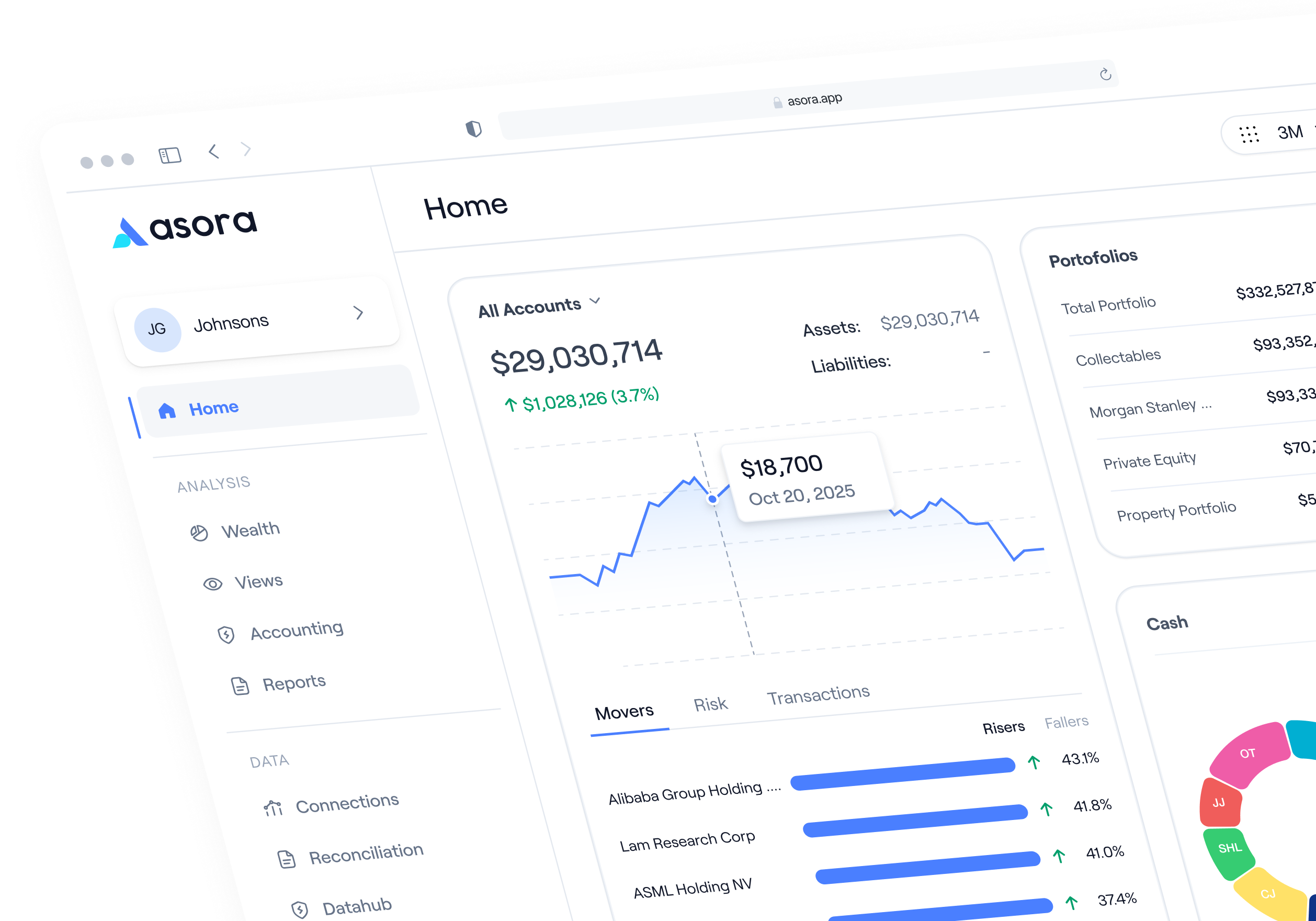
Asora was built because family offices were struggling with these exact issues. They had tools that were either too simple or too complex to use.
To solve these issues, Asora:
- Automates data aggregation across custodians, banks, and investment platforms.
- Validates and cleanses data automatically.
- Provides consolidated reporting across all asset classes.
- Handles both liquid and illiquid assets.
- Supports multi-currency portfolios.
- Scales from single to multi-family operations.
Schedule a demo to see how Asora provides clear, timely oversight across public and private assets.
FAQs
What are the most essential features in family office tools?
The most essential features are automated data integration, comprehensive validation, multi-asset capabilities, consolidated reporting, and real-time updates.
How do family office tools differ from regular portfolio management software?
Standard portfolio software focuses on public securities. Family office tools handle alternative assets, multi-entity structures, and complex ownership reporting.
Can family office tools integrate with existing accounting software?
Yes. Many integrate with platforms like Sage Intacct, QuickBooks, or Xero to synchronize transactions and eliminate duplicate entry.
What's the typical implementation timeline?
Simple setups take 4–6 weeks. Complex data migrations or multi-custodian setups may take 3–6 months.
How much do family office tools cost?
Pricing ranges from about $1,500 to $10,000+ per month, depending on assets tracked, users, and features.

.png)

.webp)