



Automate your family office
Schedule DemoHeading 1
Heading 2
Heading 3
Heading 4
Heading 5
Heading 6
Lorem ipsum dolor sit amet, consectetur adipiscing elit, sed do eiusmod tempor incididunt ut labore et dolore magna aliqua. Ut enim ad minim veniam, quis nostrud exercitation ullamco laboris nisi ut aliquip ex ea commodo consequat. Duis aute irure dolor in reprehenderit in voluptate velit esse cillum dolore eu fugiat nulla pariatur.
Block quote
Ordered list
- Item 1
- Item 2
- Item 3
Unordered list
- Item A
- Item B
- Item C
Bold text
Emphasis
Superscript
Subscript
TL;DR
Many family offices outsource specialized functions to access expertise they can't maintain in-house. Outsourcing helps you with tax preparation and investment management, and can expand access to the latest technology. This guide covers seven commonly outsourced functions in wealth management and helps you decide what makes sense for your own family office.
What to Outsource (and What to Keep)
Running a family office means balancing investment strategy, tax planning, regulatory requirements, family governance, and wealth succession, often all at once. For many families, especially lean teams or those fresh from a liquidity event, the real question isn’t whether to outsource, but which responsibilities belong with trusted partners and which are better kept in-house.
That choice isn’t binary. The right mix depends on your structure, risk tolerance, and the time you want your team spending on execution versus oversight. In the sections that follow, we break down the nuances so you can make deliberate, defensible decisions about where external expertise adds value and where direct control matters most.
Should Your Family Office Outsource?
The answer depends on several factors: your family's goals, internal resources, risk tolerance, and the specialized expertise required for specific tasks.
Let's look at seven services that family offices commonly delegate to external professionals.
1. Investment Management
Investment management is one of the most commonly outsourced functions. Unless you employ a whole investment team, accessing diverse investment opportunities often requires external expertise.
Outsourced family office services in this area typically include:
- Portfolio construction and asset allocation
- Investment performance monitoring
- Due diligence on investment opportunities
- Access to institutional-quality investments
A registered investment adviser can provide the deep understanding and specialized knowledge needed to navigate complex markets. This is valuable for families who want to invest directly in opportunities but lack the internal resources to conduct thorough due diligence.
Still, past performance doesn't guarantee future performance. Any qualified professional should help you understand both opportunities and risks aligned with your investment strategy.
2. Tax Planning and Compliance
Tax laws change constantly, and wealthy families often operate through multiple entities across different jurisdictions. This creates a regulatory burden in unique circumstances that's difficult to manage without specialized expertise.
Family office outsourcing for tax services and other services includes:
- Tax planning strategies across generations
- Preparation and filing of complex returns
- Multi-jurisdictional tax compliance
- Coordination between tax advisers and wealth managers
Even larger family offices with in-house teams often engage external tax professionals for specialized situations. For single-family offices without dedicated tax staff, outsourcing this function entirely makes practical sense.
3. Accounting and Financial Planning
Accurate financial reporting underpins every decision your family office makes. However, maintaining an in-house accounting team can be expensive.
Outsourcing accounting services provides:
- Timely, accurate financial statements
- Compliance with accounting standards
- Support for multiple entities and custodians, including multi-entity reporting
- Data aggregation across accounts and asset classes
Modern family office technology has made financial consolidation much simpler. Rather than maintaining legacy systems, many family offices now combine outsourced accounting with family office software that provides timely reporting and a single source of truth for wealth tracking.
4. Risk Management and Insurance
Families face risks that require knowledge to address appropriately. Risk management professionals help identify exposures and implement appropriate safeguards.
Outsourced family office services for risk management include:
- Insurance programme design and review
- Cybersecurity assessment and monitoring
- Disaster recovery planning
- Privacy protection strategies
This is an area where compromising service quality isn't an option.
5. Technology and IT Services
Family office technology outsourcing is increasingly common, even among well-resourced offices. The pace of technological change and the growing burden of data security make it difficult for internal teams to stay current, which is why many look to reduce costs through outsourcing.
Consider outsourcing:
- IT infrastructure management
- Cybersecurity monitoring and response
- Software implementation and support
- Integration between systems
Rather than maintaining an in-house IT department, many family offices work with specialized technology partners and use purpose-built wealth management platforms, reducing the need for custom development.
6. Estate Planning and Legal Services
Preserving wealth across future generations requires careful planning and ongoing legal compliance. Unless you operate a multi-family office with dedicated legal counsel, you'll likely need external legal professionals for:
- Estate planning and trust administration
- Entity structuring and governance
- Contract review and negotiation
- Regulatory compliance across jurisdictions
Even family offices with strong internal legal capabilities often engage external counsel for specialized matters.
7. Advisory and Personal Support
Strategic advice on major decisions (from investment opportunities to philanthropic planning) often benefits from an outside perspective. Advisory services can include:
- Strategic planning and decision support
- Philanthropic strategy
- Next-generation education
- Coordination with professionals (bankers, lawyers, advisers)
Some families also outsource personal assistant functions or concierge services, particularly when family members have evolving needs or limited time.
Family Office: In-House vs Outsourced
There's no universal answer to what should remain internal versus what should be outsourced. A thorough cost-benefit analysis should consider:
- Access to expertise: the ability to attract and retain employees with the required knowledge.
- Cost efficiency: the fully loaded cost of an in-house team relative to outsourcing.
- Control requirements: the need for direct oversight of specific functions.
- Scalability: the likelihood that needs will grow or evolve in unpredictable ways.
- Service quality: the extent to which external providers can match or exceed internal capabilities.
For a growing number of families, the answer is a hybrid approach: maintain core functions internally while outsourcing specialized services.
Outsourcing with Asora in 2026
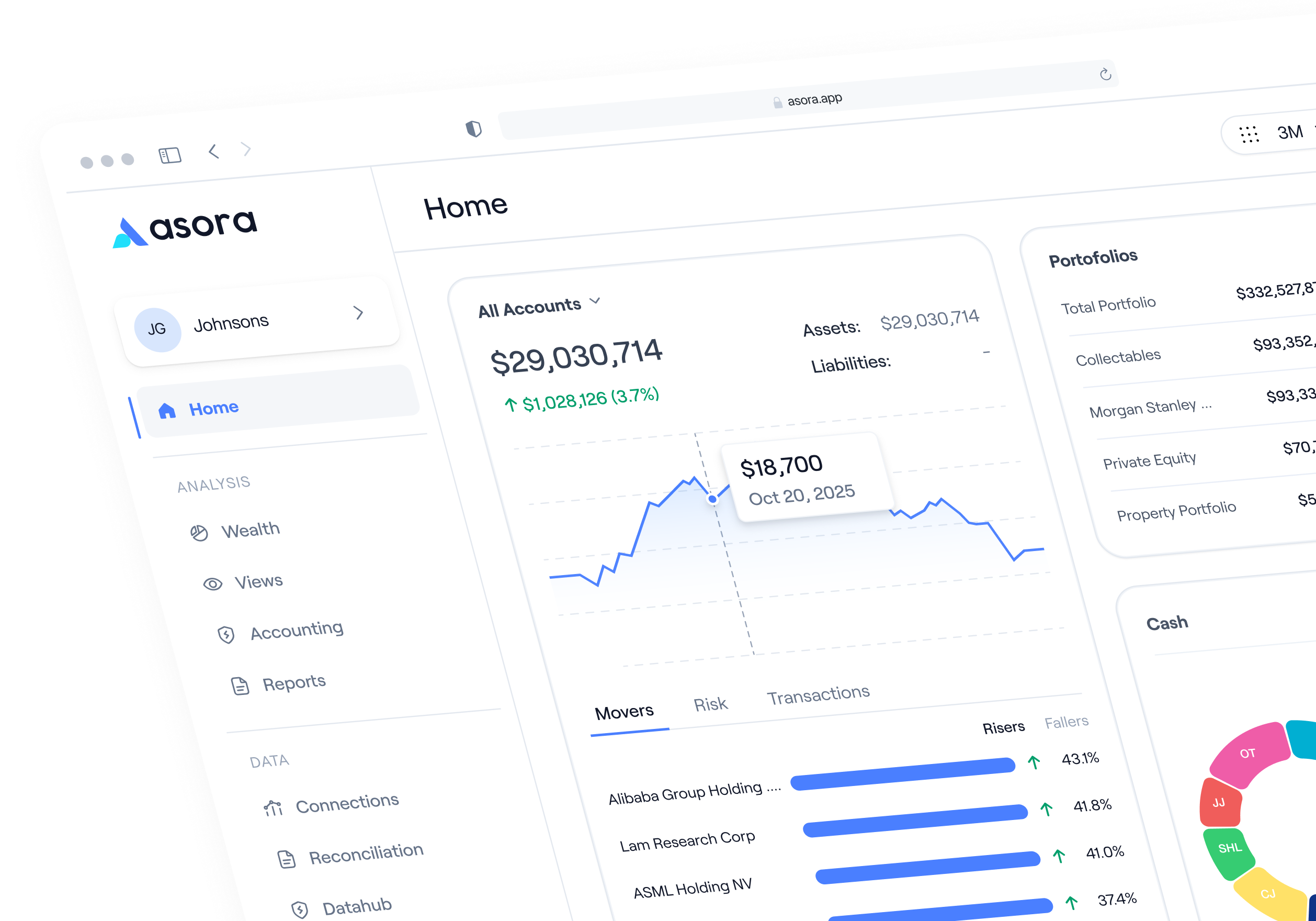
Outsource execution while keeping control. Asora serves as your operating system, providing secure, timely data aggregation across banks, brokers, private assets, and centralizing related documents and workflows in one place. External advisers work from the latest reconciled numbers, without version sprawl or unnecessary email back-and-forth.
With Asora, you keep oversight and decision-making while specialists do the work. Everyone uses a single source of truth, helping keep performance and accounting data aligned by showing TWR, IRR, book values, tax lots, and key tax fields in one place based on your underlying data feeds.”. Data refreshes on a regular cadence, and the platform flags discrepancies for your team to reconcile. Private assets are captured with the detail they require, from commitments and calls to distributions, and valuations, all tied to the correct entity and period.
Operations become easier to manage. Workflow support covers tasks so teams can see status and deadlines. Standard feeds and scoped workspaces help vendors get productive quickly, and MFA with least-privilege access reduces the risk associated with shared spreadsheets and broad file access. Reporting becomes repeatable: build clear views for principals and the investment committee and have updates flow through without extra work.
Streamline Your Family Office with Modern Technology
The emergence of purpose-built platforms has made it easier to coordinate with outsourced providers by centralizing data and workflows. Rather than building custom systems or adapting legacy software, many families now use specialized family office software that provides aggregated wealth data, performance reporting, and operational workflows.
This shift reduces reliance on internal teams for basic data management while preserving your team's focus on high-value activities, yielding numerous benefits.
Tools that provide timely visibility across all assets, from public markets to private investments, make it easier to coordinate between internal capacity and external professionals.
Learn how modern family office software can work alongside your outsourced services. Schedule a demo to see how Asora helps family offices consolidate wealth tracking across all assets and service providers.
Frequently Asked Questions
What services do family offices commonly outsource?
Investment management, tax strategy, accounting, legal services, and IT support are frequently outsourced functions. Many smaller family offices keep strategic planning and family governance in-house while delegating specialised technical work to external providers. Asora supports this split by providing users with timely, consolidated data across banks, investments, and private assets, so external teams can work with the same data your principals see.
How do I decide between a family office's in-house approach and outsourcing?
Start with a cost–benefit review of expertise, scalability, service quality, and the level of control you need. Functions that depend on family context often stay internal; highly specialised or seasonal work is a better fit for partners. Asora helps you run a hybrid model by setting granular access, keeping performance and accounting aligned in one place, and flagging discrepancies for your team to reconcile.
What are the benefits of outsourcing for family offices?
Outsourcing gives you targeted expertise, steadier costs, and flexibility as needs change, while your internal team focuses on core priorities. With Asora, you retain internal control and oversight with all documents in the same place: data aggregation delivers timely updates, private assets are tracked alongside public markets, and workflow support shows status and deadlines without relying on spreadsheets or long email threads.
Should a single family office outsource differently than a multi-family office?
Single family offices often outsource more due to lean teams; multi-family offices may keep broader capabilities in-house but still engage specialists. Either way, Asora provides a single, consistent record across multiple entities, so providers can contribute within their scope and your office maintains a clear view of ownership, performance, and books.
How does technology impact family office outsourcing decisions?
Modern platforms reduce the need for custom systems and heavy IT. Asora handles bank and custodian data aggregation, performance monitoring, document management and supports accounting and workflows, all with timely data freshness. That lets you outsource fewer IT tasks, coordinate professionals more easily, and keep decision-making in-house with timely information.

.png)